aws-cognito
Multi-Factor Authentication (MFA)
[!NOTE] Last Updated: 2026-07-31
This package provides the Multi-Factor Authentication (MFA) functionality using AWS Cognito. This documentation provides the necessary information to implement the MFA functionality in your Laravel application.
[!IMPORTANT] We have released the laravel blade components as a feature from V2.0.6. These view components have php/html blade code and javascript functions to handle MFA challenge verification within your application.
Contents
- Introduction
- Configurations
- Features
- Quick Start
- Advanced Topics
- References
- Key Points
Introduction
Multi-Factor Authentication (MFA) is a security feature that adds an extra layer of protection to user accounts by requiring users to provide additional verification during the login process. This package provides support for MFA using AWS Cognito, allowing developers to implement MFA in their Laravel applications.
The library currently provides the MFA for the Software Token and SMS based TOPT.
Configurations
AWS Configurations
In order to use the MFA functionality, you need to configure the AWS Cognito User Pool with the necessary settings. Enable the Multi-Factor Authentication (MFA) option.
Select your AWS Cognito User Pool and navigate to the Authentication > Sign-in.
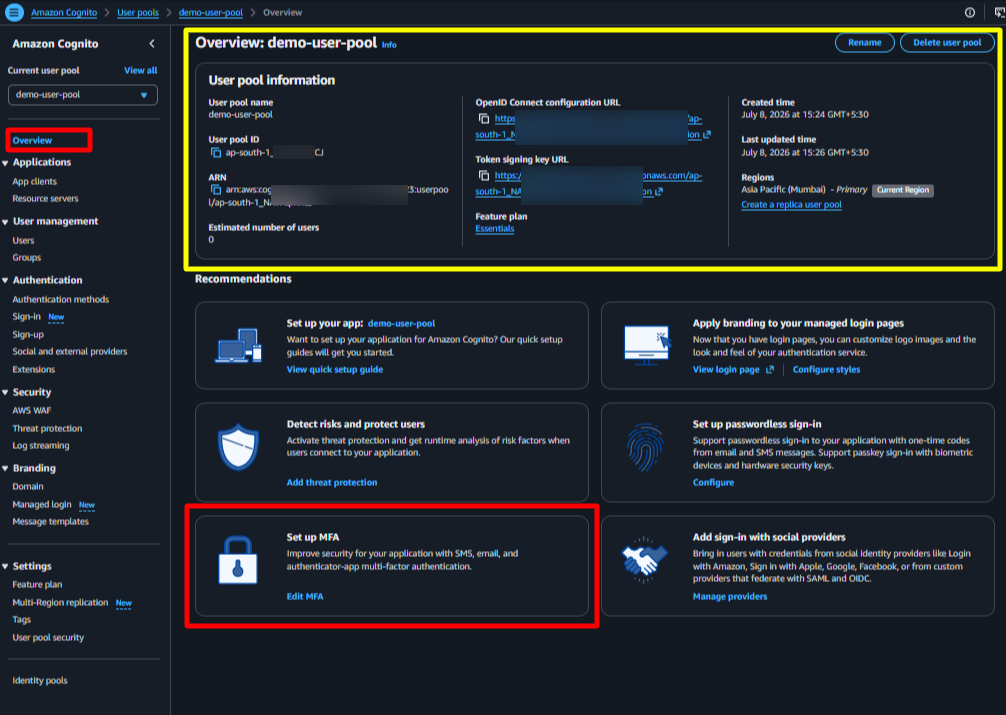
Step 1A: First time MFA configuration
Select Overview in the left navigation and browse to the Set up MFA section on the right panel. Click on the Edit MFA link to configure the MFA settings.
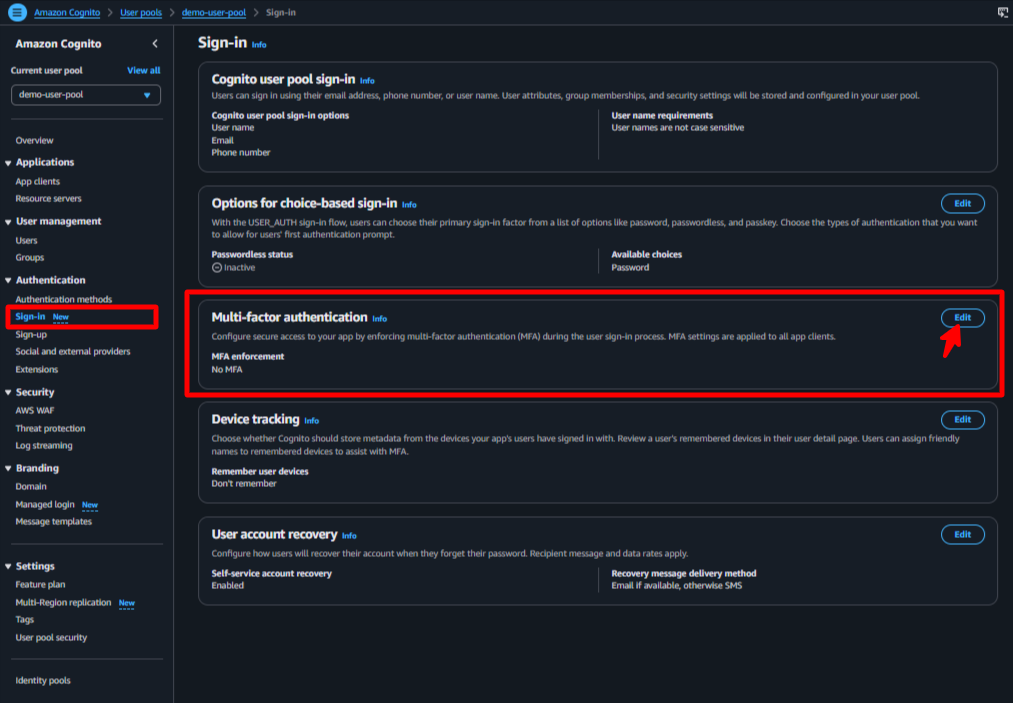
Step 1B: Amend the existing MFA configuration
If you have already configured the MFA settings, the above step 1A will not be available.
In that case, you can expand Authentication in the left navigation, and click the Sign In option. Then, browse to the Multi-Factor Authentication (MFA) section on the right panel. Click on the Edit link to configure the MFA settings, as shown below.
Step 2: Select the MFA enforcement and methods in the AWS Cognito User Pool
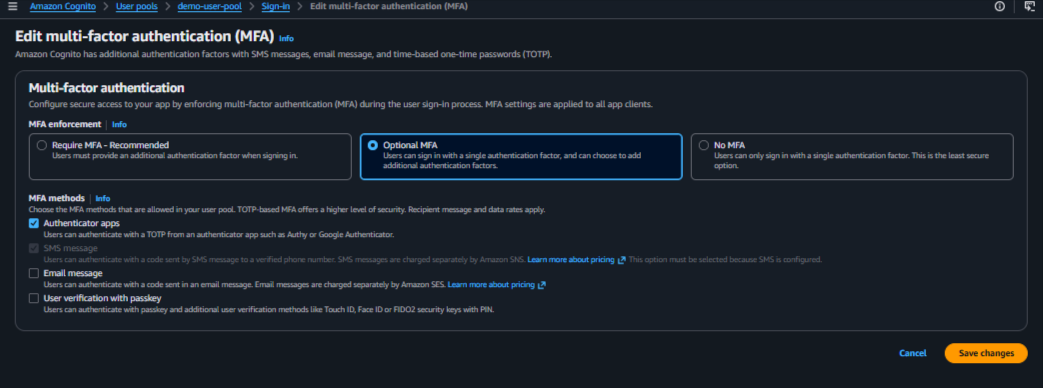
Select the desired enforcement and methods for MFA in the AWS Cognito User Pool. The available options are:
- MFA Enforcement
- Required (forces all users to set up MFA)
- Optional (allows users to choose whether to set up MFA)
- MFA Methods
- Authenticator apps for
SOFTWARE_TOKEN_MFA - SMS messages for
SMS_MFA - Email Messages for
EMAIL_MFA(not supported in this package) - User Passkeys
- Authenticator apps for
Save the changes.
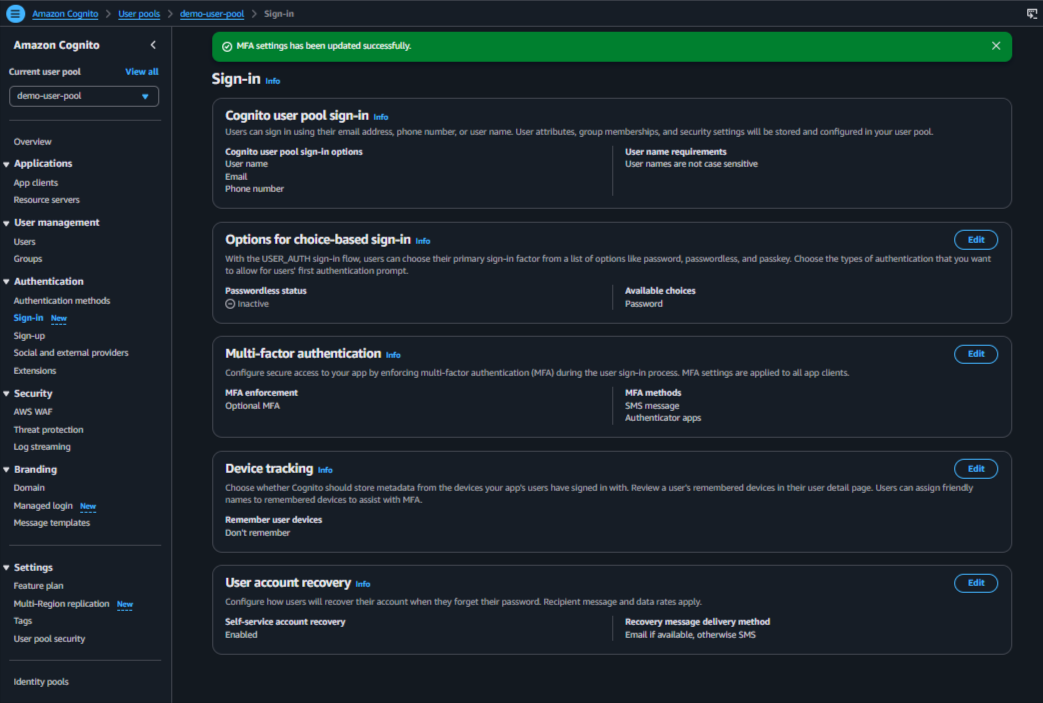
Step 3: Confirmation of saved MFA settings
Laravel Configurations
The package exposes following keys to change the default setting. These keys can be configured in the .env file or in the config/aws-cognito.php file. The default values are set in the configuration file.
-
The
AWS_COGNITO_MFA_SETUPshould be set to ON or OPTIONAL to enable the MFA feature. The default value is OFF resulting into disabled MFA functionality.When the
AWS_COGNITO_MFA_SETUPis set to OPTIONAL, the user can choose to enable or disable the MFA functionality. When theAWS_COGNITO_MFA_SETUPis set to ON, the user must enable the MFA functionality. -
The
AWS_COGNITO_MFA_TYPEcan have values SOFTWARE_TOKEN_MFA (default) for the Software Token, SMS_MFA for the SMS based TOTP, or EMAIL_MFA for the Email based TOTP. The default value is SOFTWARE_TOKEN_MFA.To support multiple MFA types, you can set the value to SOFTWARE_TOKEN_MFA,SMS_MFA. The package will handle multiple MFA types and will provide the necessary challenge to the user based on the configuration. The first MFA type in the list will be the default MFA type for the user. The user can change the MFA type in the user profile settings.
The provider configuration aids to send out the SMS from AWS with additional costs. Refer AWS SNS pricing for more details AWS SMS Pricing
    AWS_COGNITO_MFA_SETUP="ON"
    AWS_COGNITO_MFA_TYPE="SOFTWARE_TOKEN_MFA"
Features
Blade Component (web app)
The package provides a blade component for
MFA management, andMFA based authentication
The MFA based authentication component is integrated into the challenge component.
MFA based Authentication
Use the challenge component in your challenge page to handle the MFA authentication flow. The component will handle the generation of the necessary values for the MFA proof and will send them back to the server in response to the challenge.
    <form id="auth-challenge-form" method="POST" ...>
        ...
        <!-- pass the form name provided as a parameter to the component -->
        <x-cognito::challenge
            :challenge-form-name="'auth-challenge-form'" />
        ...
        ...
        @php
            $data = (session('data')) ?? null;
            $challengeNameValue = 'NONE';

            if ($data && isset($data['status']) && $data['status'] == 'challenge') {
                $challengeNameValue = isset($data['challenge_name']) ?
                    strtoupper($data['challenge_name']) :
                    $challengeNameValue;
            } //End if
        @endphp
        ...
        ...
        <div> <!-- Shows the passcode input field for the Password/OTP/TOTP based challenges only  -->
            @stack('cognito-challenge-passcode')
        </div>
        ...
        ...
        <!-- Button with data-action and data-role attribute -->
        <button type="submit"
            data-action="challenge-submit" data-role="">
            Submit</button>
        ...
    </form>

    @stack('cognito-challenge-scripts')
    ...
Using this component will simplify the implementation of the MFA authentication functionality in your application.
The data is secure, as per the cyber security standards, and the necessary scripts and methods are provided in the component to implement the MFA feature in your application.
API Documentation
This Laravel Package provides the necessary methods to implement MFA based authentication functionality provided by AWS Cognito. The available challenges are dynamically provided from the trait making the user experience aligned to the AWS SDK.
The package provides a trait RegisterMFA that you can add to your controller to provide custom functionality. The namespace for the trait is Ellaisys\Cognito\Auth\RegisterMFA.
Login with MFA
The login shall require two steps for complete the overall authentication using the MFA approach.
- Sign In using the username and password. This step shall generate the challenge.
- The second step involves passing the OTP/TOTP
codeagainst that challenge.
***Step 1***: Sign In using username and password
POST /login
Content-Type: application/json
Accept: application/json
{
    "username": "<username>",
    "password": "<password>"
}
In case the MFA is enabled and activated, then the response will be as shown below. This example generates the challenge for the user to respond with the code from the authenticator application.
{
    "status": "challenge",
    "challenge_name": "SOFTWARE_TOKEN_MFA",
    "session_token": "AYABeEkKMeJKkzhx3MK-GzS3ISIAH
    QABAAdTZXJ2aWNlABBDb2duaXRvVXNlclBvb2xzAA
    ...
    ...
    jVrz53Y1uJ3I30w46CpL9xlB50IbVJ0SNYY_tuFsLc
    GjYfDpn7XQcd6-fXWovCIYoMH5Q",
    "challenge_params": {
        "FRIENDLY_DEVICE_NAME": "<friendly_device_name>",
        "USER_ID_FOR_SRP": "<username>"
    },
    "username": "<username>"
}
***Step 2***: Respond to the challenge with the code from the authenticator application
POST /challenge
Content-Type: application/json
Accept: application/json
{
    "challenge_name": "SOFTWARE_TOKEN_MFA",
    "session": "<session_token_from_step_1>",
    "username": "<username>",
    "challenge_value": "<code_from_authenticator_app>"
}
Software Token MFA Functionality
The Software Token MFA functionality allows users to enable and manage MFA using a software-based authenticator application. The package provides the necessary methods to activate, verify, and deactivate the Software Token MFA for users.
Activate MFA
The activate process allows the user to configure the Software MFA. To configure the Software Token MFA setting on the mobile device, a key or the scan code (easy to consume), is available for use on any of the authenticator applications (i.e. Google Authentictor OR Microsoft Authenticator).
The process completes when the code is verified using the Verify MFA step.
Web and API based Approach
The function call looks as shown below. Just reference the the method activateMFA, with the guard name as a parameter, in the trait that you added above in configuration. This shall activate the Software MFA token.
public function actionActivate()
{
try {
        return $this->activateMFA('api'); //Pass the guard name for web/api calls
    } catch(Exception $e) {
        throw $e;
    } //Try-catch ends
} //Function ends
The response that you will get for the API call would look this
{
    "SecretCode": "ESKPE46WBNOAB7QXXXXXXXXXXXXXXXXXXXPFIVJVJFEPDP2NNIA",
    "SecretCodeQR": "https://chart.googleapis.com/chart?chs=200x200&cht=qr&chl=otpauth://totp/ApplicationName (john@doe.com)?secret=ESKPE46WBNOAB7QXXXXXXXXXXXXXXXXXXXPFIVJVJFEPDP2NNIA&issuer=ApplicationName&choe=UTF-8",
    "TotpUri": "otpauth://totp/ApplicationName (john@doe.com)?secret=ESKPE46WBNOAB7QXXXXXXXXXXXXXXXXXXXPFIVJVJFEPDP2NNIA&issuer=ApplicationName"
}
and the web response, you can design a page like this to show the code for activating the Software MFA token.
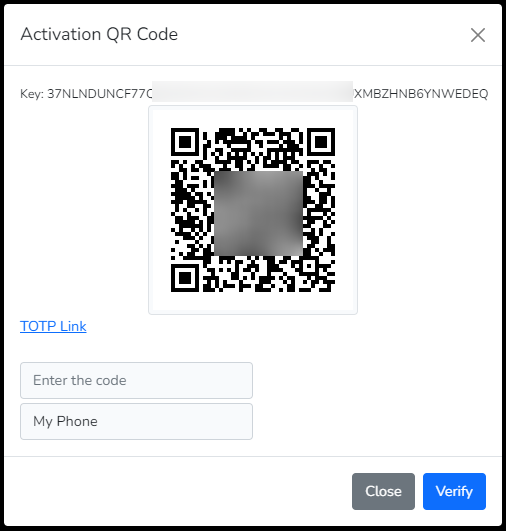
[!IMPORTANT] In case you want to change the QR Generator library, you can change the value in the configuration file with the key mfa_qr_library. Alternately, you can set the string in the environment file identified by AWS_COGNITO_MFA_QR_LIBRARY.
Verify MFA
In order to complete the activation process, the verification is an essential step. As part of this verification process, you need to enter the code (available in the authenticator application) while submitting the request. The implementation needs to be updated depending on the web or API controller. The response will be HTTP Status Code 200.
public function actionVerify(string $code)
{
try {
        return $this->verifyMFA('api', $code); //Pass the guard name for web/api calls and the MFA code from the device
    } catch(Exception $e) {
        throw $e;
    } //Try-catch ends
} //Function ends
Deactivate MFA
In order to deactivate the MFA for the authenticated user, this endpoint can be called to deactivate the MFA. In most practical situations, you can skip this implementation, based on your application requirements. However, if you want to provide this feature, you can implement the following method in your controller.
In order to enable/disable a user’s MFA setting by an admin, based on your RBAC implementation, you can use the Enable and Disable endpoints.
Below curl helps deactivate the user’s MFA, returning the HTTP Success Code.
POST /user/mfa/deactivate
Content-Type: application/json
Accept: application/json
Authorization: Bearer <access_token>
Enable MFA
This feature allows the admin user to enable MFA using an email address. The developer must implement the RBAC to ensure this feature is not misused.
Below curl helps enable the MFA returning the HTTP Success Code.
POST /user/mfa/enable
Content-Type: application/json
Accept: application/json
Authorization: Bearer <access_token>
{
    "username": "<username>"
}
Disable MFA
This feature allows the admin user to disable MFA using an email address. The developer must implement the RBAC to ensure this feature is not misused.
Below curl helps disable the MFA returning the HTTP Success Code.
POST /user/mfa/disable
Content-Type: application/json
Accept: application/json
Authorization: Bearer <access_token>
{
    "username": "<username>"
}
API Routes
[!NOTE] We are releasing the API predefined routes as a new feature from V1.3.0.
php artisan vendor:publish –provider=”Ellaisys\Cognito\Providers\AwsCognitoServiceProvider” –tag=”controllers”
For the list of published routes and configurations, please refer API Routes